www.rogerknapp.com

Search this site

Established 1997

Medical             Scouts         Family
Recipes           Inspiration     Jokes      Miscellaneous
Pictures            Quotes          Links


Recommended Childhood Immunization Schedule United States,

This schedule indicates the recommended ages for routine administration of currently licensed childhood vaccines for children through age 18 years. Any dose not given at the recommended age should be given at any subsequent visit when indicated and feasible. =Indicates age groups that warrant special effort to administer those vaccines not previously given. Additional vaccines may be licensed and recommended during the year. Licensed combination vaccines may be used whenever any components of the combination are indicated and the vaccine's other components are not contraindicated. Providers should consult the manufacturers' package inserts for detailed recommendations. Clinically significant adverse events that follow immunization should be reported to the Vaccine Adverse Event Reporting System (VAERS). Guidance about how to obtain and complete a VAERS form can be found on the Internet or by calling 1-800-822-7967.
See schedule web site at CDC: http://www.cdc.gov/vaccines/recs/schedules/child-schedule.htm


1. Hepatitis B vaccine (HepB). (Minimum age: birth)

At birth:

·  Administer monovalent HepB to all newborns prior to hospital discharge.

·  If mother is HBsAg-positive, administer HepB and 0.5 mL of hepatitis B immune globulin (HBIG) within 12 hours of birth.

·  If mother's HBsAg status is unknown, administer HepB within 12 hours of birth. Determine the HBsAg status as soon as possible and if HBsAg-positive, adminis-ter HBIG (no later than age 1 week).

·  If mother is HBsAg-negative, the birth dose can only be delayed with physician's order and mothers' negative HBsAg laboratory report documented in the infant's medical record.

Following the birth dose:

·  The HepB series should be completed with either monovalent HepB or a combination vaccine containing HepB. The second dose should be administered at age 1-2 months. The final dose should be administered at age >_ 24 weeks. Infants born to HBsAg-positive mothers should be tested for HBsAg and antibody to HBsAg after completion of 3 or more doses in a licensed HepB series, at age 9-18 months (generally at the next well-child visit).

4-month dose of HepB:

·  It is permissible to administer 4 doses of HepB when combination vaccines are given after the birth dose.

2.  Rotavirus vaccine (Rota). (Minimum age: 6 weeks)

    • Administer the first dose between 6 and 14 weeks of age. Do not start the series at age 15 weeks.

o       Administer the final dose in the series by 8 months.

    • If Rotarix is administered at ages 2 and 4 months, a dose at 6 months is not indicated.

3. Diphtheria and tetanus toxoids and acellular pertussis vaccine (DTaP).

(Minimum age: 6 weeks)

    • The fourth dose of DTaP may be administered as early as age 12 months, provided 6 months have elapsed since the third dose.

    • Administer the final dose in the series at age 4-6 years.

4. Haemophilus influenzae type b conjugate vaccine (Hib). (Minimum age: 6 weeks)

·                    If PRP-OMP (PedvaxHIB or ComVax`' [Merck]) is administered at ages 2 and 4 months, a dose at age 6 months is not required.

·                    TriHiBit' (DTaP/Hib) combination products should not be used for primary immuniza-tion but can be used as boosters following any Hib vaccine in > 12 month olds.

5. Pneumococcal vaccine.- (Minimum age: 6 weeks for pneumococcal conjugate vaccine (PCV); 2 years for pneumococcal polysaccharide vaccine (PPV))

  • Administer PCV to all children less than 5 yr old.  Give one does to ages 24-59 months who are not completely vaccinated.

  • Administer PPV to certain high-risk groups aged >_ 2 years. See MMWR. 2000;49(RR-9):1-35.

6. Influenza vaccine. (Minimum age: 6 months for trivalent inactivated influenza vaccine (TIV); 2 years for live, attenuated influenza vaccine (LAIV)

  • All children aged 6mo -18 yr.

  • For healthy persons aged 2-49 years, LAIV may be used as an alternative to TIV .

  • Children receiving TIV should receive 0.25 ml if aged 6-35 months or 0.5 mL if aged >_ 3 years.

  • Children aged < 9 years who are receiving influenza vaccine for the first time should receive 2 doses

7. Measles, mumps, and rubella vaccine (MMR). (Minimum age: 12 months)

  • Administer the second dose of MMR at age 4-6 years. MMR may be administered prior to age 4-6 years, provided >_ 4 weeks have elapsed since the first dose and both doses are administered at age >_ 12 months.

8. Varicella vaccine. /Minimum age: 12 months)

  • Administer the second dose of varicella vaccine at age 4-6 years. Varicella vaccine may be administered prior to age 4-6 years, provided that >_ 3 months have elapsed since the first dose and both doses are administered at age >_ 12 months. If second dose was administered >_ 28 days following the first dose, the second dose does not need to be repeated.

9. Hepatitis A vaccine (HepA). (Minimum age: 12 months)

  • HepA is recommended for all children at 1 year of age (i.e., 12-23 months).  The 2 doses in the series should be administered at least 6 months apart.

  • Children not fully vaccinated by age 2 years can be vaccinated at subsequent visits.

  • HepA is recommended for certain other groups of children including in areas where vaccination programs target older children. See MMWR. 2006;55(RR-7):1-23.

10. Meningococcal polysaccharide vaccine (MPSV4). (Minimum age: 2 years)

  • Administer MPSV4 to children aged 2-10 years with terminal complement deficiencies or anatomic or functional asplenia and certain other high-risk groups. Now required for entry into Texas 7th grade.  We usually give it at 12 yr old.


1.Tetanus and diphtheria toxoids and acellular pertussis vaccine (Tdap).

(Minimum age: 10 years for Boostrix ' and 11 years for Adacel IT"')

  • Administer at age 11-12 years for those who have completed the recommended childhood DTP/DTaP vaccination series and have not received a Td booster dose.

  • Adolescents 13-18 years who missed the 11-12 year Td/Tdap booster dose should also receive a single dose of Tdap if they have completed the recommended childhood DTP/DTaP vaccination series.

  • A 5 yr interval from the last Td dose is encouraged when Tdap is used as a booster dose; however, a shorter interval may be used if pertussis immunity is needed.

2. Human papillomavirus vaccine (HPV). (Minimum age: 9 years)

  • Administer the first dose of the HPV vaccine series to females at age 11-12 years.

  • Administer the second dose 2 months after the first dose and the third dose 6 months after the first dose.

  • Administer the HPV vaccine series to females at age 13-18 years if not previously vaccinated.

3. Meningococcal vaccine. (Minimum age: 11 years for meningococcal conjugate vaccine (MCV4); 2 years for meningococcal polysaccharide vaccine (MPSV4))

  • Administer MCV4 at age 11-12-years and to previously unvaccinated adolescents at high school entry (- 15 years of age).

  • Administer MCV4 to previously unvaccinated college freshmen living in dormitories; MPSV4 is an acceptable alternative.

  • Vaccination against invasive meningococcal disease is recommended for children and adolescents aged > 2 years with terminal complement deficiencies or anatomic or functional asplenia and certain other high risk groups. See MMWR 2005;54 (RR-7):1-21. Use MPSV4 for children aged 2-10 years and MCV4 or MPSV4 for older children.

  • Now required for entry into 7th grade.

4. Pneumococcal polysaccharide vaccine (PPSV).

  • Administer for certain high-risk groups. See MMWR 1997; 46(RR-08); 1-24 and MMWR 2000; 49(RR-9):1-35.

5. Influenza vaccine. (Minimum age: 6 months for trivalent inactivated influenza vaccine (TIV); 5 years for live, attenuated influenza vaccine (LAIV)

  • Influenza vaccine is recommended annually for children 6mo to 18yr.

  • For healthy persons aged 5-49 years, LAIV may be used as an alternative to TIV.

  • Children aged < 9 years who are receiving influenza vaccine for the first time should receive 2 doses (separated by >_ 4 weeks for TIV and >_ 6 weeks for LAIV).

6. Hepatitis A vaccine (HepA). (Minimum age: 12 months)

  • The 2 doses in the series should be administered at least 6 months apart.

  • HepA is recommended for certain other groups of children including in areas where vaccination programs target older children. See MMWR 2006; 55(RR-7):1-23.

  • This is now required in Texas to inter Kg and 7th grade.

7. Hepatitis B vaccine (HepB). (Minimum age: birth)

  • Administer the 3-dose series to those who were not previously vaccinated.

  • A 2-dose series of Recombivax HB® is licensed for 11-15 year olds.

8. Inactivated poliovirus vaccine (IPV). (Minimum age: 6 weeks)

  • For children who received an all-IPV or all-oral poliovirus (OPV) series, a fourth dose is not necessary if third dose was administered at age >_ 4 years.

  • If both OPV and IPV were administered as part of a series, a total of 4 doses should be given, regardless of the child's current age.

9. Measles, mumps, and rubella vaccine (MMR).(Minimum age: 12 months)

  • -If not previously vaccinated, administer 2 doses of MMR during any visit with >_ 4 weeks between the doses.

10.Varicella vaccine. (Minimum age: 12 months)

  • -Administer 2 doses of varicella vaccine to persons without evidence of immunity.

  • -Administer 2 doses of varicella vaccine to persons aged <_ 13 years at least 3 months apart. Do not repeat the second dose, if administered >_ 28 days following the first dose.

  • Administer 2 doses of varicella vaccine to persons aged >_ 13 years at least 4 weeks apart.

  • Now 2 doses are required in Texas for entry into Kg and 7th grade as of 2009.

Dr. Knapp's personal choices in these vaccine recommendations.

I have adapted the above schedule to help not giving so many shots at one time.
Many are now required for starting Kg and 7th grade in Texas.  The shots below are required.

Birth not if Mom neg test
2months Pentacel #1     PCV#1
4months Pentacel #2     PCV#2
6months Pentacel #3   PCV#3 HepB#1
9months   HepB#2
12months HepA PCV#4 HepB#3 MMR#1  
18months DaPT#4 HIB HepA   Varicella 1
4yr DaPT #5 IPV#4       MMR#2 Varicella 2
12yr Tdap Menatra   HPV 3 over 6 months or Varicella 2 here

 A combination of vaccines were released called the Pentacel that contains DaPT, IPV, and HIB all in one shot.  So that will mean fewer needles especially at 2,4,and 6 months.  At 2 months the baby gets two shots: Pentacel and Prevnar(PCV).

I am now recommending not give the HepB vaccine at birth unless the mother is Positive for the virus.  Studies show that the immunity is better in the teenage years if the vaccine is given at 6 months or later.  The infant is not exposed to the virus except at birth or as an adult.   Also as mothers are coming to us having been vaccinated to HepB, then we need to wait until their antibodies (that goes through the placenta to the baby) decrease and not affect the infants vaccination. 

Texas is requiring the Tdap, Menatra and a second Varicella (chicken pox)  before 7th grade as of Fall 2009.  At 12 yr we give a new Tetanus booster with Pertussis (Whooping Cough) called a Tdap.  This has to be 5 yrs or more past the last tetanus shot so if you had one at 12-14 yr, then you cannot have one for 5 yr after that.  Also a vaccine called Menatra.  This is for Meningiococcal Meningitis.  It is required by most colleges, we have given it for many years to 12 yr olds, and now required by Texas to enter the 7th grade.  This vaccine is one only and will satisfy requirements getting into college or the military service.  The second Varicella vaccine is required unless the parent signs a form at school that the child had the chicken pox illness.

I recommend the Human Papilloma Virus Vaccine (HPV) by 12-13 yr. old girls and boys.  The virus causes cervical cancer, cancer of the mouth, genital warts, nodules on the vocal cords, and prostate cancer.  The virus DNA is found in more than 50% of prostate cancer and none in normal prostates.  It is 3 shots over 6 months: one initially, one 2 months later, and the third 4 months after the second one.   This vaccine does not increase the promiscuity rate.  It is safe and I strongly recommend it. 10% of the population have the virus by 20 yr old, 50% by 26 yr old, and 80% by 50 yr old.  Plus you could be a virgin at 30 yr and marry a spouse with the virus.

HepA is now required for Kg.  It is recommended for high risk groups in the teens who have not had it.  Especially they need it if they go to under developed countries with poor sanitation.  Or if they go into health care fields like paramedics, doctors, nurses, etc.

The Rotavirus vaccine I do not recommend at this time.  It is a live virus and also causes diarrhea in some infants.  The chances of getting the virus in the first 2 years is only slightly higher than the incidence of diarrhea from the vaccine.  This vaccine is not required at this time.  If the parent wants it given to the baby,  you will have to see the county clinics for that vaccine.  It changes the illness from 12% to 7%.  And side effects are 5% or more.

New requirements for Fall 2009 School year in Texas: 

  • Meningococcal Vaccine*
    • Beginning SY 2009-10, 7th grade requirement
  • Varicella Vaccine
    • Beginning School Year (SY) 2009-10, 2 dose requirement for kindergarten and 7th grade entry Unless they had disease.
  • Tdap Vaccine
    • Beginning SY 2009-10, a booster dose requirement for Tdap for 7th grade
  • MMR Vaccine
    • Beginning SY 2009-10, 2 dose requirement of MMR vaccine for kindergarten entry
  • Hepatitis A Vaccine
    • Beginning SY 2009-10, 2 dose requirement for kindergarten entry statewide

AND NO ...... THE VACCINES DO NOT CAUSE AUTISM!!!

For those parents who have been brainwashed by Dr. Sears.  Please read this article:
Dr Robert Sears, The Vaccine Book: Making the Right Decision for Your Child.

Dr. Knapp

PDF of vaccine schedule 0-6yr   7-18yr


Vaccine schedule from CDC: http://www.cdc.gov/vaccines/recs/schedules/child-schedule.htm

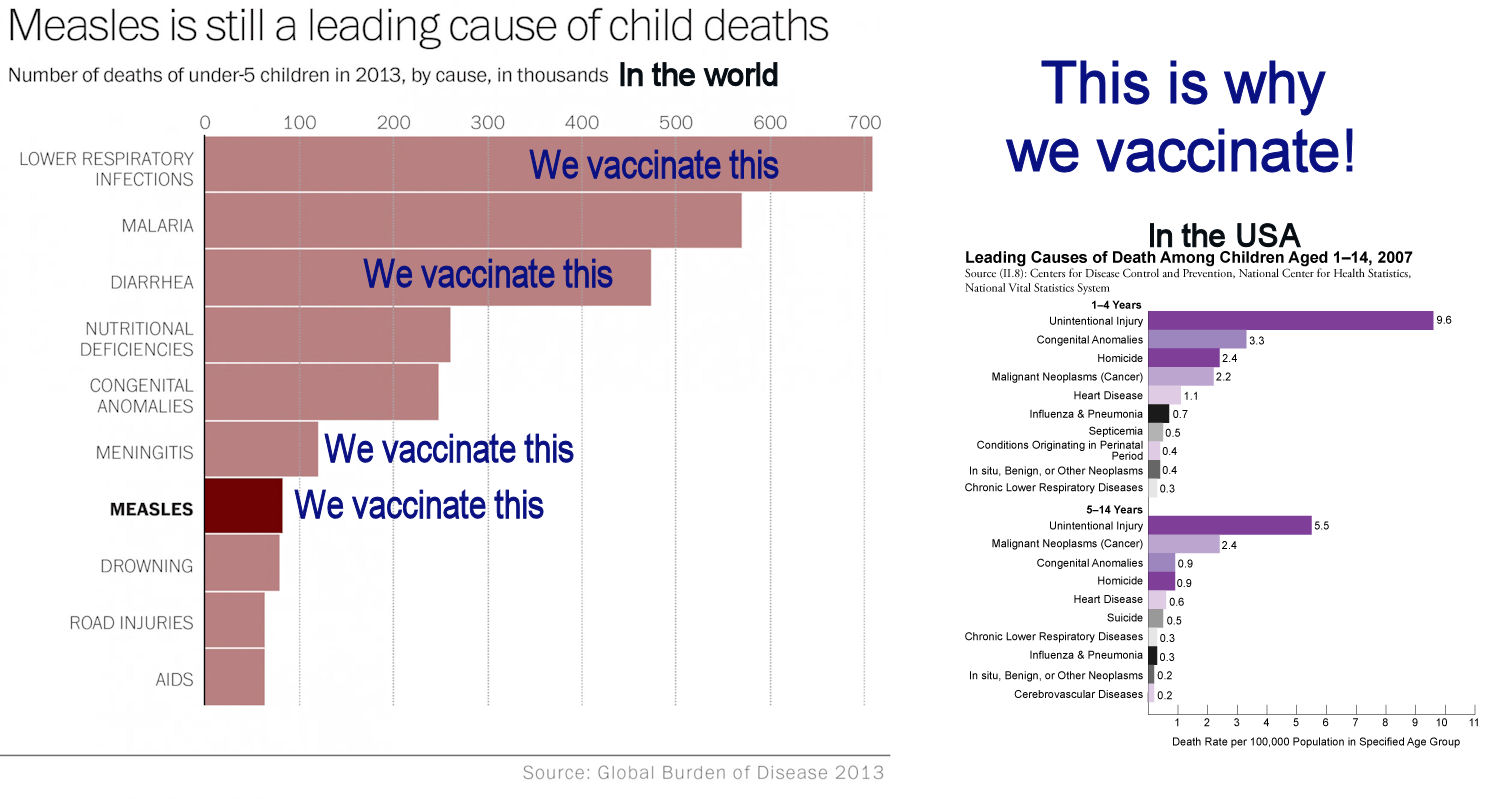
Why Vaccinate?

Web sites with more info:
1. www.cdc.gov
2. www.vaccinealliance.com
3. www.vaccine.org
4. www.immunize.org
5. www.immunizationinfo.org
6. www.fda.gov/oc/opacom/kids/html/vaccines.htm
7. www.who.int/vaccines/